May 18, 2012by Mark Rose- 6 comments
Boost your earnings, without changing your strategy
Perhaps your trading strategy is ticking along nicely, bringing you in enough of a profit to make your efforts worthwhile …
Perhaps you’re struggling, and feeling like you’re giving back as much as you gain from the markets …
Either way, what if I told you there was a way to increase your returns and reduce your risk?
This isn’t a new trading strategy.
It doesn’t involve learning new technical indicators or spending more time watching charts.
It’s simply about being smarter with the money you put into the market.
The most important tool any trader has isn’t his strategy … it isn’t his discipline … or his technical know-how.
The single most important thing in your trading is your trading fund.
Sure, you should only trade with money that you can afford to lose, but you should treat that money with the kind of respect you’d treat your last pound with.
Your trading fund is EVERYTHING to you – so please, please, don’t be flippant about your staking strategy.
There are two key ways that most traders can improve their staking: first, by being less casual about their risk; and secondly, by rejecting a “one size fits all” approach to staking techniques.
I’ll explain each of these in detail here …
Getting serious about staking
A good staking plan is all about capital preservation.
It is generally agreed that whenever you place a trade, you should never risk more than 2 or 3% of your capital. So, if you use a staking plan of 3% per trade and have £1000 in your trading account, for example, then you would be prepared to lose no more than £30.
Many, many traders risk considerably more than 3% of their pot, because they want to make money faster. This kind of trading shows a disregard for our principle of “capital preservation”.
If you’re risking 8% per trade, just 8 losing trades in a row (which isn’t an uncommon event with a lot of trading strategies) will wipe nearly 50% off your fund. To earn back that 50%, you’ll need to increase your diminished trading fund by a whopping 100% – that’s just to get back to breakeven.
It simply isn’t worth taking these kinds of risks with your capital. Just be patient, accept small, steady gains. Growth may seem modest in the early days, but if you reinvest your winnings, you’ll find that you can really generate genuine long-term wealth this way.
So, provided you’re staking in a sensible, cautious way, what’s the next step you can take to boost your wealth and reduce your risk?
Stakes – one size does not fit all
To maximize profits, a trader needs to know when to take them.
However long you trade for, you will always struggle with taking profits too early or too late. I doubt that you’ll ever feel that you’ve got it “just right” – I know that I don’t!
However, with practise, we can get better at it.
The trick is to lock in profits when possible, without compromising our ability to profit when the markets run.
And this is where a “one size fits all” approach can work against us.
Not all trading opportunities are equal. There are circumstances when it is more likely that the market will keep on running. For example, if there’s been considerably volatility … if there’s little support/resistance to stop it … if there’s significant volume and momentum …
All these factors can tell us that we should be looking at ways to take advantage of a big market move.
And I can’t think of a more appropriate time to be looking for a technique that allows you to profit from big moves. With the Eurozone, yet again, in turmoil, we can expect to see some serious volatility in the months ahead.
So, how do we do it …?
Applying trailing stops … the smart way
Trailing stops can be a fantastic tool for traders. But they can also be our downfall.
This is how they work …
A trailing stop is a dynamic stop loss level that reacts to the price of the instrument you’re trading.
Let’s say that you’ve bought the FTSE at 5400, and put your stop in 20 points below at 5380.
Now, let’s say that the price moves up to 5480, bringing you 80 points into profit.
If your stop loss is a trailing stop, it will move up with the price – so your new stop loss level will now be 80 points higher, at 5460.
(On some platforms, you can set the increments a trailing stop moves in – i.e. it will only jump up after a 10 or 20 pip move.)
That way, even if the price turns against you, you’ve locked in 60 points profit.
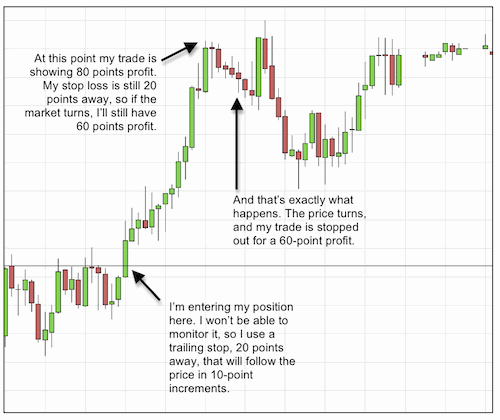
A trailing stop can help us to take advantage of a big move, even if we can’t be around all day watching our screens.
It can also help to protect us from a sudden news story causing the market to turn tail …
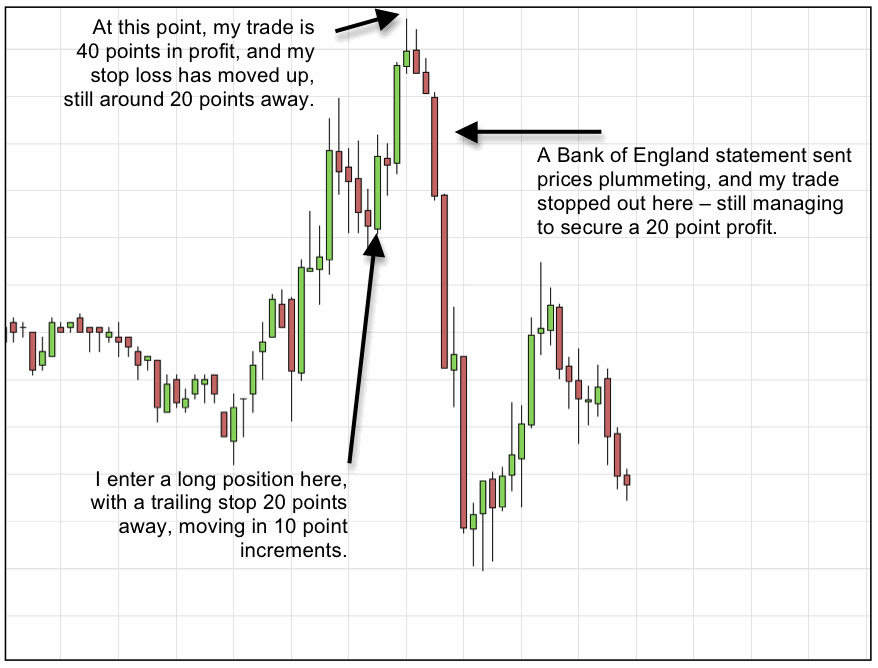
Here, a normal stop loss would have left us out of pocket, but with a trailing stop, we’ve managed to pull in a small profit from a bad situation.
But it’s not all good news with trailing stops …
Because they’re following the price, you can easily find your stop loss “dangling” at a dangerous level, where a volatile market will knock it out.
And in a volatile market, it’s more important than ever to let our trades have room to breathe. If a trailing stop is following every twist and turn of the price, you could struggle to ever hit your profit targets, as a small retracement takes you out of your trade for a far smaller profit than you were hoping to make.
One way to get around this problem is to actively manage your trades, only adding a trailing stop, once you’re happy that the market has moved sufficiently. That way, you can add a trailing stop, risking just 5 or 10 points, because you believe that the trade still has “legs”.
However, most traders don’t have the time to sit and manage their trades this proactively. Fortunately, there’s another way you can use automated trailing stops to take advantage of some of the big moves that we’re expecting in the markets – without compromising your carefully planned trading levels.
Here’s how …
On some trading platforms, you can adjust the increment in which your stop moves.
So, we can instruct our trailing stop to stay put, until the market has reached a key level – at which we’d feel confident to move our stop.
Here’s an example …
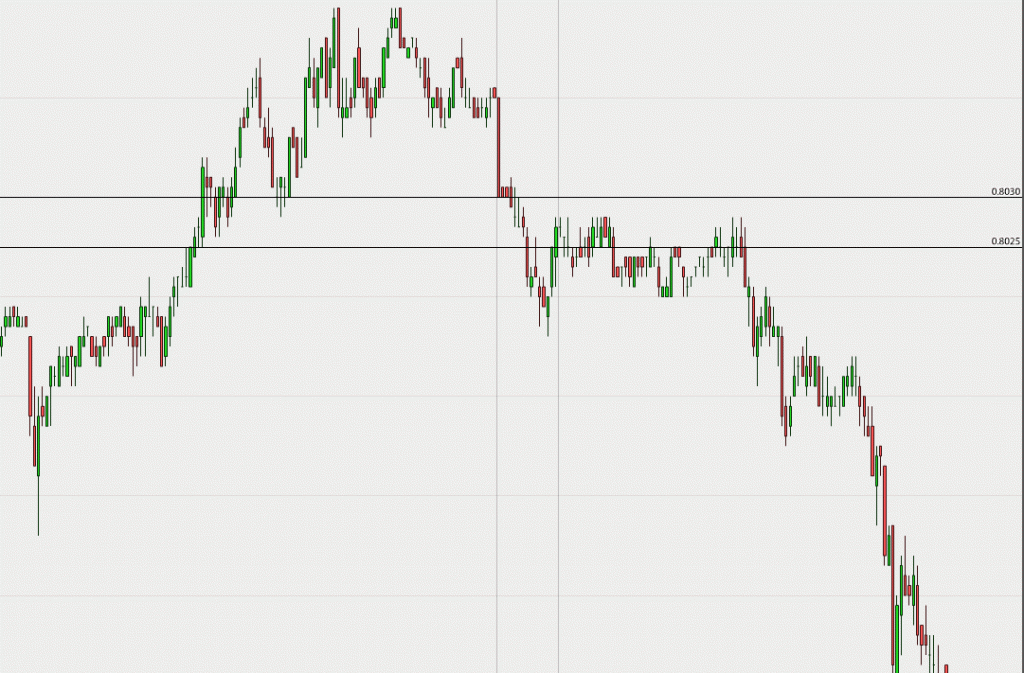
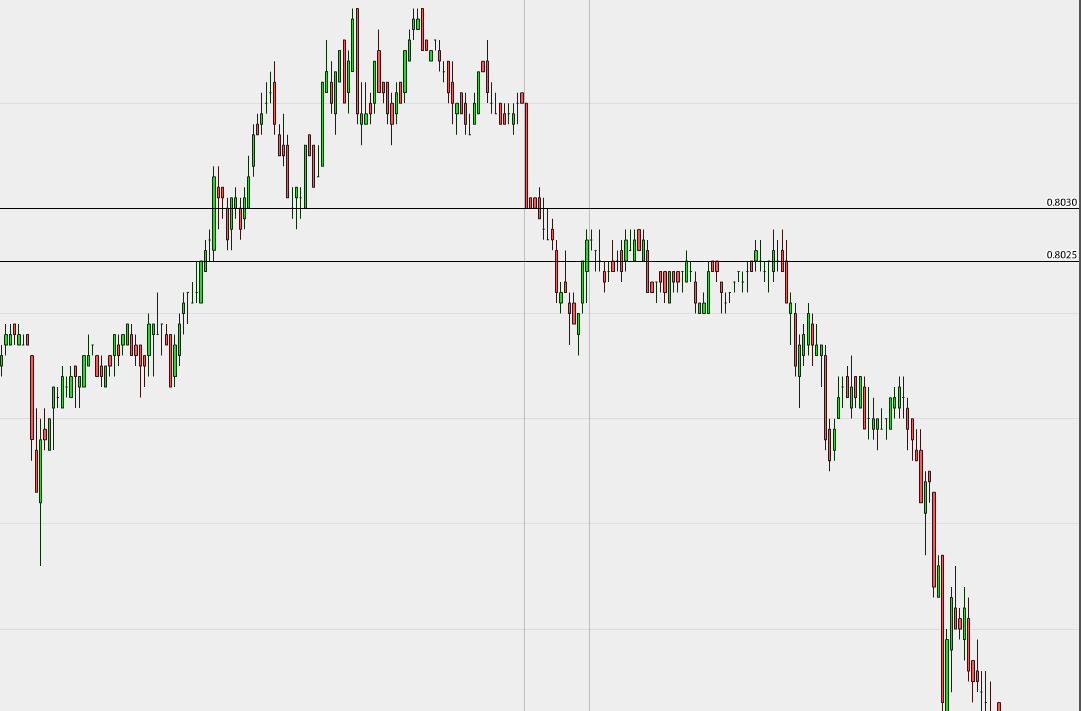
In this example, we’ve decided to short the euro at 0.8025, and we want to put our stop loss in just above this at 0.8030.
I’m feeling very bearish on the euro – I think it could make a big downward move, and I’d like to take advantage of that. I’m also happy that my stop level is a technically sensible one, just above an area of resistance.
However, a 5-pip stop is very tight to be using in such a volatile market, so I don’t want to use a straight-forward trailing stop that will follow every twist and turn in the price. I’d quickly be knocked out of my trade that way.
Instead, I decide that I don’t want my stop loss to move down until we’re approaching resistance at around 0.800. So, I’ll set the increment on my trailing stop to 23 pips. That way, my tight stop loss won’t move until the price hits 0.8002, and I’m 23 pips in profit.
This is what happens …
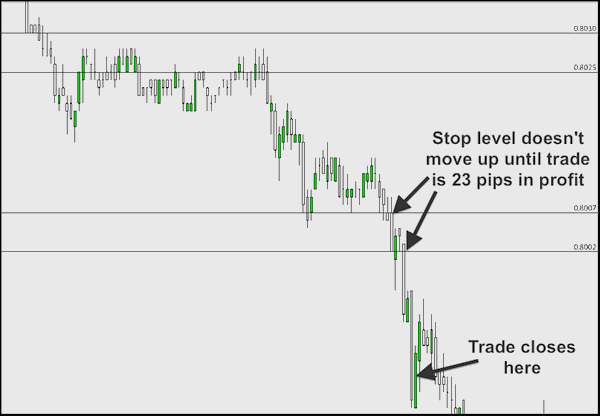
Using this technique, I’ve managed to let the trade run to an extra 15 pips profit, while keeping a tight, but technically savvy stop loss.
PLUS – I haven’t had to sit at my desk managing this. It’s all set up automatically with my trade.
You can find this kind of adaptable trailing stop on ETX Capital.
It’s another reason why I think that the ETX platform is one of the best about. This kind of automation can make a huge difference to the amount of time you need to spend at the screen, without compromising on have a well-managed trade.
And of course, you probably already know how highly I regard their charting package, that allows you to trade directly though your charts.
And remember, if you want to try out ETX Capital, by using the Trader’s Bulletin link, you can also access their generous £300 safety-net deal.






6 comments
Dave Whitehead
Hi Mark,
I’ve just noticed the caption on the chart also needs changing.
Dave
Mark Rose
It’s a good job one of us is on the ball! Images are a little more tricky to correct, but I’ve flagged that up on the to-do list. Thanks again.
Dave Whitehead
Reading the section below, should move UP really be move DOWN as you are shorting?
Instead, I decide that I don’t want my stop loss to move UP until we’re approaching resistance at around 0.800.
Dave Whitehead
Mark Rose
Thanks for spotting that one – I’ve corrected the text now. Cheers, Mark
kat marquardt
Can you use “ETX Capital” if you live in the U.S.?
Great tips – you explained everything very clearly!
Thank you!
Mark Rose
Hi Kat, I’m afraid not; you’d have to look at a US broker. Mark