March 4, 2011by Mark Rose- 0 comments
Two simple ways to profit from round numbers

Today I’d like to talk about what must be the easiest trading indicator to spot.
If you can count to 10 – you can find this one.
It’s based on a strange quirk of how the human brain works – and it can be very important in trading. It can protect your money from losses – and it can earn you some quick and easy profits.
What I’m talking about are round numbers – and the almost magical effect they have on prices.
Here I’m going to show you how you can protect your funds by seeing these numbers as “danger zones”.
And then I’ll show you a trick for turning that on its head – and earning profits by learning how to profit from round numbers, focusing in on these numbers as “profit zones”.
The lure of the round number
Human beings are suckers for round numbers. It seems that our brains work best with approximations. When we hear pundits talking about the markets, they use figures like: “If shares get down to £8, they’d be worth buying” or “X shares would be overbought at £25.”
And these round numbers appeal to traders when they are placing their limit orders, their profit targets and their stop losses.
Buyers will often purchase large amounts of stock once the price starts to fall toward a major round number, such as £20. And this buying pressure makes it more difficult for shares to fall below that level.
Or, sellers will start to sell off stock as it moves towards a round number peak, making it tricky for the price to move past this upper level.
This kind of buying and selling pressure turns innocent-looking round numbers into important psychological levels of support and resistance.
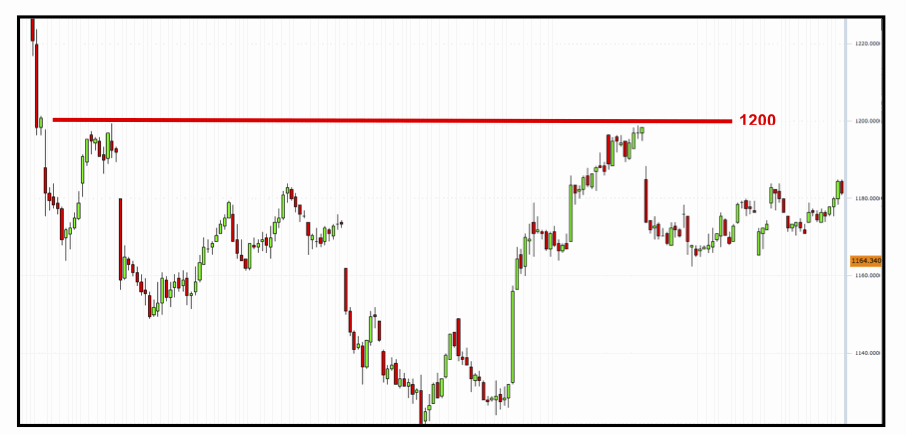
In the chart below, you can see a stock price bouncing off resistance at the psychological level of £12.00 – each time it reaches this level, sellers come in and push the price back down.
What makes a number round?
It’s not just for stocks, it happens across all markets, and what counts as a round number will depend on the price of that instrument.
For example, a high-price stock might experience the “round number effect” at £75, £80, £85, £90 …
A lower-price stock might experience it at £7.00, £7.50, £8.00, etc …
For penny shares, you’d be looking at 10p increments, and in forex markets it happens at GBP/USD 1.9600 … 1.9700 … etc
The round number effect is going on all over the place!
As I said earlier, this week I’m going to talk a little about the potential dangers of trading around these round numbers. I’d then like to go a step further and look at how you can turn these dangers into potential profits – but that’ll have to wait until next week.
Round one: the first thing you need to know about how to profit from round numbers
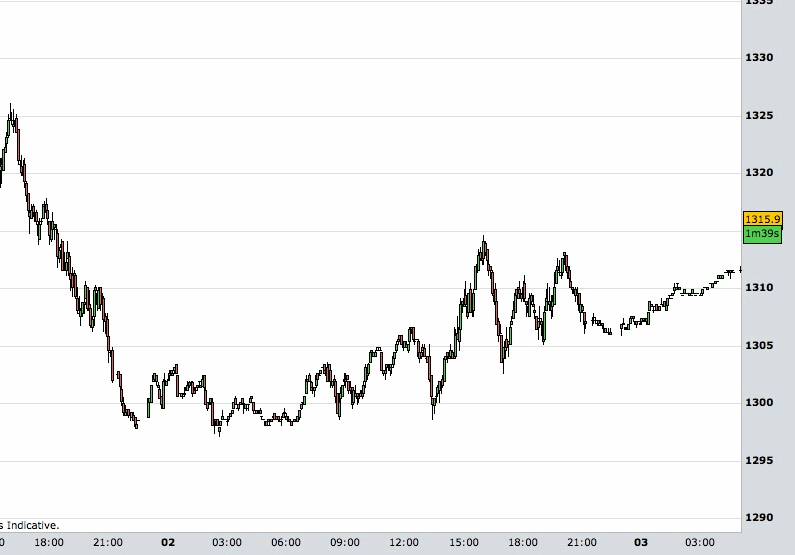
As we’ve seen, the allure of round numbers makes them natural areas of support and resistance. Take a look at this chart for the S&P500, showing the price repeatedly bouncing off support at the 1300 level.
Many traders will use these areas of support to initiate a trade – for example, going long when the price hits the round number, or a few pips below the round number. They are then looking to profit from the bounce-back.
Traders will also use round numbers as stop-loss levels. If you believe that the market will find support around the 1300 level, then you’re likely to place your stop loss just below that level.
If you look closely at the chart above, you’ll notice that the price often moves down through the 1300 level before bouncing back.
This is the first important thing that we learn about round numbers as traders – to avoid placing our orders too close to them. Otherwise we’re likely to be knocked out of our trades just as the price is changing direction.
How to avoid the congestion charge
Let’s say you’re placing a buy order on company X at £2.70, and you want to place your stop loss around 20p below this figure – you should avoid sticking your stop order on at exactly £2.50. Because many traders are naturally drawn to round numbers, there will be “congestion” around this number. Therefore, you’re better off placing your stop loss below this area of congestion, so you don’t get caught up in it.
There’s no hard-and-fast rule for how close you can get to a round number with your stop loss – it will depend on the volatility of the instrument, the strength of that support/resistance level (i.e. how many times the price has bounced off it already), and there’s no shortage of other indicators we can use to make the judgment.
Despite this, many traders still choose to place their orders within just a few points of round numbers. As you’ve seen on the S&P chart above, a lot of the “bounce” happens just beyond the round number – because this is where all the traders have their orders (in the belief that they are clear of the “round number congestion”)
As with all support and resistance, I find it useful to think of them as “areas” of support or resistance rather than “levels”.
So, when you place your stop losses and profit targets, spare a thought for the thousands of other traders who are quite probably thinking what you’re thinking.
The game of desperately trying to avoid round numbers can be a tiresome one, which is why next week I’d like to talk about a different game – one that hones in on these same round numbers, and uses their “magical” powers to make profits.
Click here to keep reading and find out how to turn this on it’s head, with a round-number profit trick