March 11, 2011by Mark Rose- 0 comments
Turning round numbers into profits

In my last post, I gave you some sound reasons to avoid round numbers, and this week I’d like to turn that theory on its head …
If lots of traders are losing money by having their stop losses and profit targets too close to round numbers – other traders must be profiting at their expense.
These traders are called the stop-loss hunters – they’re the ones who are lining their pockets every time our trades get “touched out”.
I expect you know what it feels like – having your trade stopped out, only for the market to turn around in your favour. It’s a feeling I know all too well.
So, if you’ve ever felt that your stop losses are being hunted out, today I’d like to show you a way to get your own back on the stop-loss hunters – and boost your profits into the bargain.
It’s to do with round numbers again – and it’s incredibly simple.
Are your stops being hunted?
Last time I talked about the areas of congestion that build up around round numbers, as prices struggle to move beyond them.
I showed you this chart from the S&P500, where you can clearly see congestion around the 1300 level:
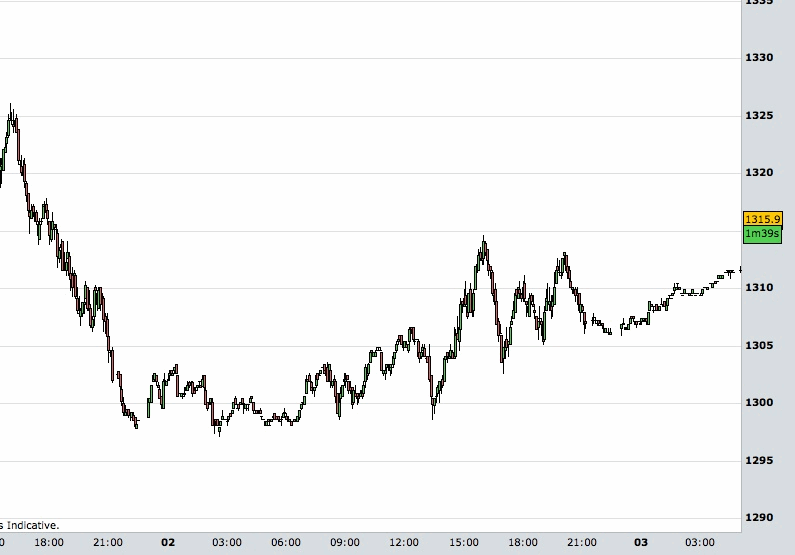
What we talked about last week was the importance of giving the price some “breathing room” around these round numbers, so rather than putting a stop loss at 1300, you put it a safe distance below.
So, now we know the dangers of round numbers …
Great – you’ve avoided the first trap!
You’ve carefully placed your stop loss just below the big round number, so you don’t get snarled up with all the novice traders who are placing their stops at exactly 1300.
What does the price do?
It comes down to 1297, touches you out, and then turns right back around.
It’s frustrating when it happens, and you feel like you’re being hunted out.
And the simple truth is that you are being hunted, by the big-time stop-loss hunters who profit by knowing exactly where we lesser mortals are going to place our stop losses.
Well, today, we’ll look at exactly how to play the hunters at their own game.
Which brings me neatly to the second way you can profit from round numbers …
Round two: turning a springboard into a magnet
The truth is that most traders, believing that they are outsmarting the stop-loss hunters, place their stops a couple of points either side of round numbers.
This is a fact, and traders can take advantage of this knowledge – and profit from it.
These clusters of orders can give prices a natural momentum around round numbers. This momentum has the effect of transforming the round number from a spring board for a price reversal into a magnet that attracts price levels to it.
What this means is that rather than bouncing off round numbers without touching – prices are often drawn to round numbers and experience “congestion” at these levels.
So, if we see a price level approaching a round number – we can take the opportunity to ride that bit of momentum that carries the price closer towards, and through, the round number.
Here’s how it can work:

Here we see some congestion around the price of GBP/USD at 1.6000.
I’ve drawn on the chart two lines around 15 pips either side of 1.6000 to create a “channel”.
Now notice how when the price enters this “channel” it (more often than not) gets pushed on through 1.6000 – this is the momentum I’m talking about. And this is where traders take advantage of your stop losses – picking up a profit every time the price moves through this channel. They may enter a short position at 1.6015, and take their profits close to the 1.6000 level. Next, they’ll pick up a profit coming the other way – when the price moves through 1.5985, they’ll enter a long position, taking profits again around 1.6000.
Stop losses on this type of trade are kept very tight – if the price isn’t rapidly carried towards the round number, then the set-up is invalidated.
What it means to your trading
There’s no “big secret” about this type of trade – there are plenty of traders out there using it and profiting from it. However, as with most things in life, it’s not always as simple as it looks.
The first question is whether the round number is going to act as a springboard or a magnet. Past areas of support and resistance and other technical indicators can gives us clues to this one, but it’s impossible to always predict this correctly.
If you are interested in this type of trading, you should also bear in mind that the margins are tight – once you’ve taken into account the cost of the spread, and the possibility of slippage, you’re only looking at scalping a few pips on each trade.
Whether you’re tempted by these profits or not – it’s definitely worth knowing that others out there are. It may make all the difference to how you position your stop losses in future.
Save