January 17, 2014by Mark Rose- 2 comments
Stop sprinting, go the distance
2013 was the year that I hung up my running shoes. Possibly for good (bad back … bad knees …) But that’s not the kind of distance I’m talking about here.
If you want to make serious money from trading, without kissing goodbye to good risk management, you need to learn to go the distance – letting your winners run. This ‘distance run’ is a percentage of your trade that you leave open as long as possible while the trade is moving in your direction.
We’ve all heard the advice to “Cut your losses and let your winners run” – but actually applying this principle is very challenging. Here I want to look at the pitfalls, and how you can successfully navigate the long-distance run …
Typically, when a trade moves into profit, traders are keen to pat themselves on the back and exit with a nice profit before anything upsets those gains. Sometimes the market will then reverse, confirming their decision as a good one. However, other times, the market will keep on moving, leaving our trader frustrated at missing out on a profit.
Of course, we shouldn’t be greedy, we shouldn’t try to push too hard for profits, and we need to keep disciplined. However, that doesn’t mean that we shouldn’t be ambitious enough to get the very best out of our trading strategies.
Trading by its very nature is going to be close to the edge. The markets don’t just give us money. We have to work at it. And we have to be constantly battling to improve the edge we have over the market.
If you have a strategy with a high success rate (i.e. you win a lot more trades than you lose), then your winners will be significantly smaller than your losers, and you’ll be constantly on guard to maintain profitability.
If you have a strategy with a fantastic reward-to-risk ratio (i.e. your winners make several times what your losers lose), then you’ll undoubtedly have a lot of losses compared to winners, and will be constantly on guard to maintain profitability.
What I’m trying to say is that staying profitable, long-term, just isn’t simple, and we have to work at ensuring our winners make as much as they possibly can.
I speak to just too many traders who spend their lives winning … giving back all their profits … winning … giving back all their profits. There’s a very subtle distinction between that and winning … giving back a chunk of that profit … winning … giving back a chunk of that profit …. Psychologically, these two scenarios don’t feel all that different, but only one is going to have long-term profitability.
And the distance runner is a key tool in ensuring that you’re in the profitable camp …
Here’s how it works …
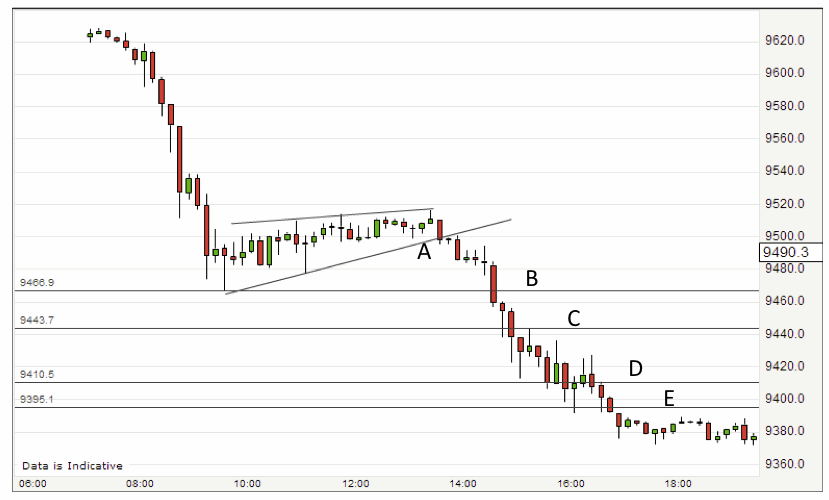
In this example, we’re trading a breakout after a consolidation in a downtrend.
When the price breaks out of the pennant formation at A, we’re into a sell trade. We have a tight stop loss, so can get a decent risk-reward ratio by taking profits very quickly at B.
It’s a tidy result – we’ve done well to keep our risk tight, and we’ve got in fast, and taken our profit quickly.
But there’s still a lot of profit on the table. Surely there must be a way to take advantage of this, without adding risk.
We’ve looked at trailing stops in Trader’s Bulletin many times, and weighed up the pros and cons of using them – they can be great if the market is moving fast. But they can leave us with clumsy, vulnerable stop levels.
It takes a bit of active management, but we can do better than this …
I’ve marked up on the chart other historical support levels, which could be targets for the price on its way down. We’re still going to close out 50% of our trade at B – this means that we’ve banked some money. We can then move our stop loss to breakeven and the rest of our trade is risk-free.
Now we have level C in our sights …
Once C is hit, we’ll tighten our stop level up again to B, and we’re aiming for D. Now our worst case scenario is closing both halves of the trade for a profit at B.
When D is hit, we may push further, for profits at E (again, tightening the stop to C) – or we may decide we’re happy with this move. This isn’t a process that continues on and on until the market reverses (as would happen with an automated trailing stop). We’re trying to be smarter here – we’re using support/resistance levels and being realistic about the kind of move this market can make.
This is also a great way to use Fibonacci levels. If you need an update on Fibs, check out the website HERE.
By working on this technique, you can get more out of your trading strategy. Sure, it does take managing, but for me the very best things about this distance run is that you are in a risk-free trade and you’ve already paid the spread on this trade – you’re playing the market without taking risk and without paying a thing to your broker. What could be better than that?







2 comments
Barry
Hi Mark
When you say close out 50% of the trade how do you do that do you put 2 trades on then close out one at the first target then let the other run.This may sound a dumb question but i am not sure what you mean.
Thanks Barry
Mark Rose
Hi Barry,
You can close part of your trade by adjusting the staked amount. So if you placed a trade for £2 a point and wanted to take half the profits, you can close £1 of the trade leaving £1 running.
I’d recommend opening a demo account and having a play.
Regards,
Mark Rose