May 6, 2011by Mark Rose- 0 comments
Should I be investing in silver?

The news on Sunday night that Osama Bin Laden had been killed caused a lot of strange spikes on the markets.
Some traders believed that this heralded the beginning of more political stability … others were concerned that a period of reprisals was on the way.
But, when President Obama announced the news, the fall in the price of silver had already begun …
Something else was at play here.
Silver: the story
There’s been a lot in the press over recent months about silver.
“The poor man’s gold”, as it is often touted, has had a meteoric rise this year.
To get a full picture of just how big and how fast this has been, you have to look at a long-term chart. This one dates back to 1985 …
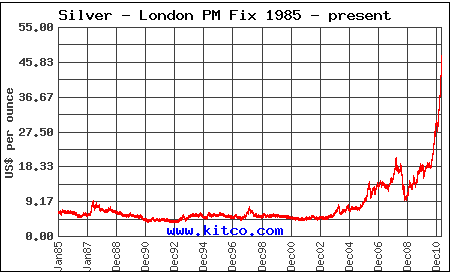
The sudden move, which began in the second half of last year, isn’t entirely unprecedented. Take a look at this older chart, dating back to 1792 …
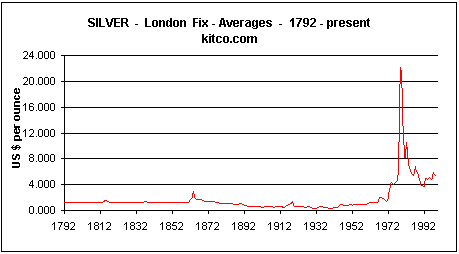
This spike was caused by the famous Hunt brothers’ accumulation of silver in the late 70s. The price rose almost four-fold in the space of as many months – and then fell back even more sharply.
So, what’s caused the huge rally in silver this year – and what’s behind the sudden sell-off we’ve seen this week?
Why the big rush into silver?
Precious metals traditionally do well in times of turmoil – we only have to look at gold prices for confirmation of this.
However, silver has been a late and rather extreme entry into this game. Between August 2010 and the end of April 2011, it gained 175 per cent. In the same period, gold rose 28 per cent.
In my opinion, silver gains are the result of what George Soros called “reflexivity”.
Reflexivity is a circular market theory – you get the fundamentals … traders make decisions based on those fundamentals … and then these decisions affect the fundamentals … and so on …
The result is the kind of feedback loop that leads us straight into boom and bust cycles.
Silver prices have risen … the rise has been talked up in the financial press … more investors have been attracted … which pushes the price up further.
I’ve spoken to many investors who felt aggrieved that they’d “missed out” on the big gold story, so wanted silver to be the “new gold”.
This “wanting” may have fuelled some of the rises we’ve seen.
Perhaps I’m being too dismissive of these gains – certainly, commodities are very strong at the moment, across the board, and silver had some catch up to play.
The same drivers that have lifted gold (economic uncertainty, geopolitical instability, inflationary pressures) are present for silver, even if they seem to have had a dramatically outsized effect.
And proponents of silver will tell you how silver – unlike gold – has an inherent value. While gold’s value is really based on what anyone will pay for it, silver has a number of practical industrial applications, in batteries, bearings, soldering, electronics and as a catalyst.
Whether any of these applications can justify a price over $40 / ounce, however, seems less likely.
The big pop …
So, now lets take a look at the correction that’s appeared in the last week – is it a sign that the party’s over, or is it merely a buying opportunity?
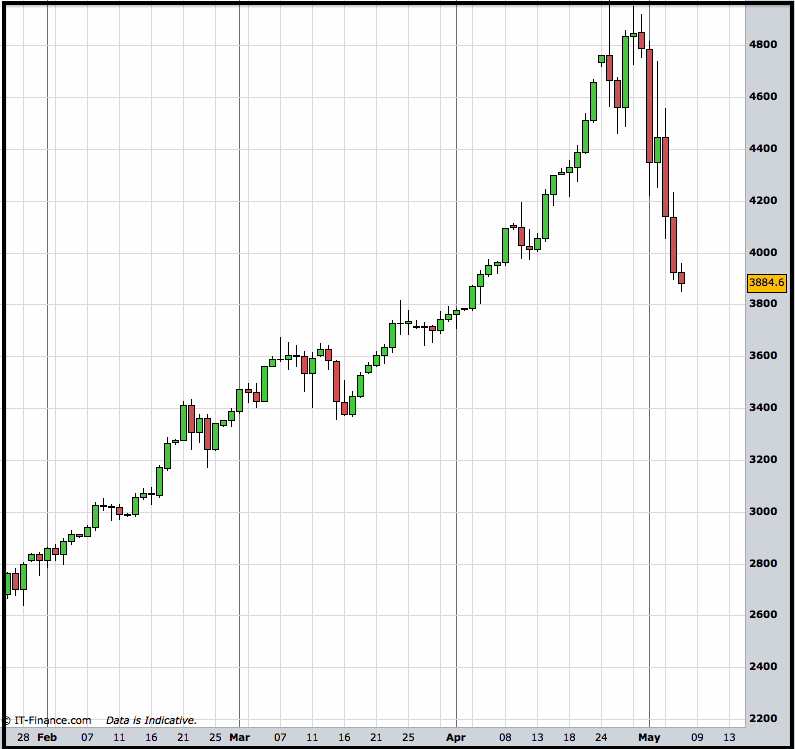
This is what began on Sunday night …
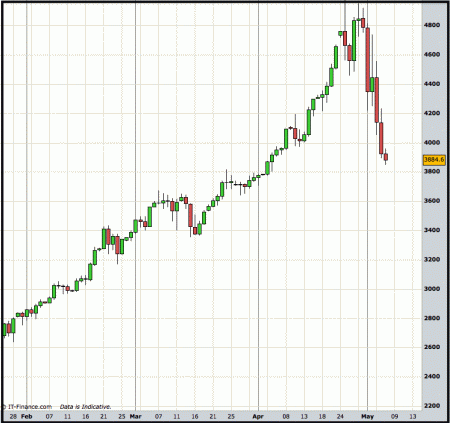
When the Asian markets opened on Monday morning, two weeks of gains were wiped out in the space of 11 minutes.
What’s got investors so spooked?
Some of the sell-off was caused by the imposition of higher margin requirements, making holding silver more expensive for investors.
Then rumours began … rumours that one of the biggest silver bulls in the world, Eric Sprott had started selling.
And despite Sprott’s claims that he is still investing in silver, the sell-off has continued through the week.
There’s that feedback loop at work again.
Has the bubble burst? It certainly looks that way on the charts. Many investors will have made a great deal of money – those who bought early and got out at $49, or even at $40. Those who’ll have lost out are the smaller traders who got in late.
Silver presents us with a useful lesson – particularly to those who keep ploughing more and more of their funds into the gold market. Markets go up, and they go down – it is the traders job to evaluate the risk involved in those positions, and to weigh up just how much they are paying to get in.
For me, whether silver is heading down or is simply in a correction – well, I reckon it’s got further to fall before we see any upside, but the simple truth is that it’s anyone’s guess. What’s vital to consider here is the mind-numbing volatility of this market. The price of silver moved by more than 300 points on Wednesday, and by 500 points on Tuesday – this is no place for anyone with a faint heart or shallow pockets.
Until next week,
Mark Rose