March 21, 2014by Mark Rose- 0 comments
How to manage a trade

Okay, so you’ve placed your trade – the set-up looked perfect. Now you can sit back and wait for the cash to roll in, right?
Well, that’s one way to trade.
But if you can manage your open positions, it can bring you bigger profits … lower risk … the stimulation of active trading … and (let’s be honest here) more work to do!
I like a lazy, set-and-forget system as much as the next man, but that’s not the only trading I do.
Alongside quick and simple strategies (like Wall St Time-Shift Trader), I’ll also be actively managing other trades in the markets.
And it’s these trades that give me the biggest headaches … the biggest profits … and the biggest thrills (not that I trade for thrills, you understand – that would be reckless!)
Traders must tread a fine line between “managing trades” and “fiddling with trades”. And it’s the difficulty of distinguishing which of these you’re doing that makes set-and-forget strategies such a god-send to those of us who aren’t always as disciplined as we should be.
If we’re trading right, then we’ll be always trading with a plan, so I thought it might be useful to take a look at the things we should do to manage our trades, and the things we should be leaving well alone …
Trade management: preparing for the unexpected
A lot can happen between the time you open a trade and the prices hitting one of your trade levels, so staying on top of the market can be a good idea.
Fresh news stories are hitting the markets all the time – sometimes they have a big impact on prices, sometimes not. But, by definition, news is new, so we can’t have accounted for it in our trading plans.
Some things, like regular economic announcements will be scheduled, and we can plan in advance what we’ll do when they come out (be it avoid trading, or adjust our trade depending on whether the announcement is positive or negative).
These announcements can creep up on us when a trade has been open for longer than we expected – so try to know what’s coming up.
Let’s say that we opened a position early in the day on Eur/USD. We expected it to have closed out within a couple of hours, but this one is still running. It’s in profit, but still just 5 points short our target. It’s lunchtime, and the markets are slowing down ahead of a big announcement from the US Fed at 1.30pm. The announcement could give it the impetus to push through our target, but it could equally send the price in the opposite direction.
I decide to forego those last 5 points and take my profit now. It’s not worth gambling the money I’ve got on the table for just an extra 5 points.
This kind of thing works fine when we know that news is about to come out. But sometimes news comes unexpectedly, and can seriously unsettle our best-made trading plans.
The only way that we guard against these kind of eventualities are by always having an automatic stop loss and profit target in position, so we can profit when the price shoots in the right direction, and we’re protected when it moves in the wrong direction.
If a sudden news spike hasn’t closed our trade, we should always look back at our original set-up and ask ourselves: Are the reasons that I got into this trade still valid? If they are – then sit tight. If not, it could be time to adjust your exit strategy.
Moving with the markets
Making adjustments as your trade progresses can all be part of your well-thought-out trading plan. This might involve the use of techniques like scaling in and out of trades, or applying trailing stops.
You can find out more about both of these techniques in previous posts here:
How scale out
How to use trailing stops
Or it might involve following the progress of trend lines which can influence your profit targets or stop losses, as in this example …
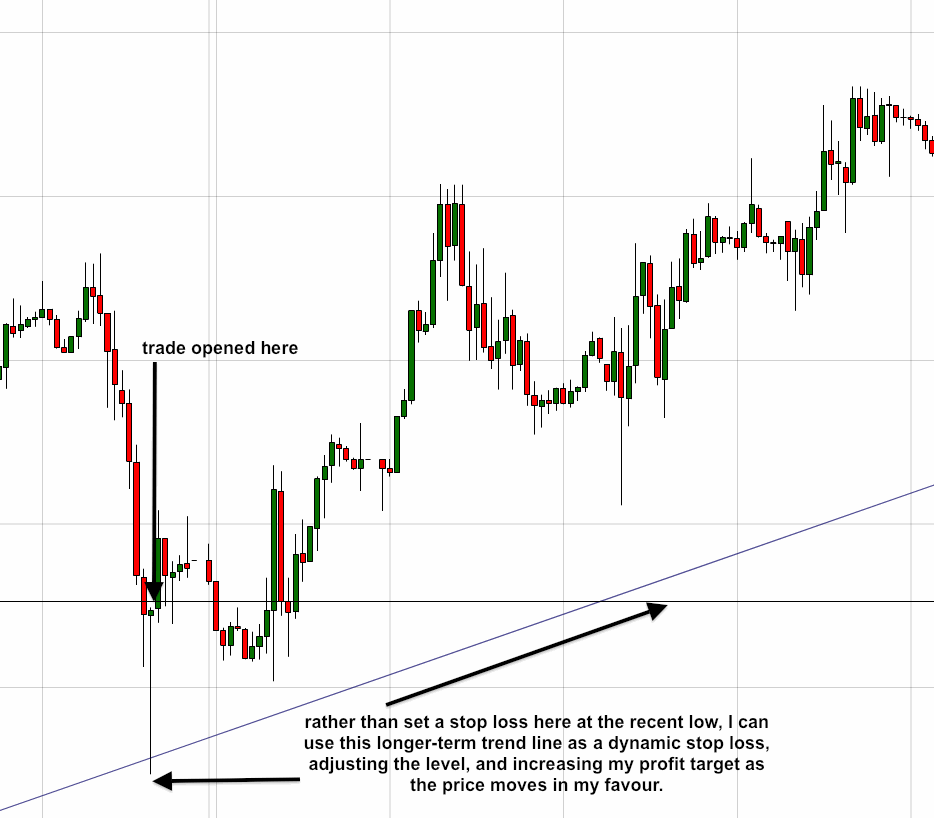
But, if you’re going to be flexible, my advice is to always err on the side of caution. Otherwise, your flexibility can quickly slip into recklessness. If you’re moving your profit target – move your stop loss in the same direction. So, if you’re long, and you move your profit target up, move your stop loss as well. And if you’re short and you lower your profit target, lower your stop loss too.
If you’re adding to a position (ie increasing your stake) only do this to a winning position (never add to losers), and ensure that you adjust your stop loss so that you aren’t doubling up your risk.
Active trade management is more about protecting funds and profits than trying to “push it” for bigger and better returns. As ever, successful trading is about keeping in the game, day in, day out, rather than chasing big winners.