June 24, 2011by Mark Rose- 0 comments
How can you profit from the Greek crisis
I arrived late at my desk this morning from dropping the kids at school, having witnessed a nasty collision outside the school gates.
I also witnessed the very different ways people respond to a crisis – the mum who pulled a mountain of gauze and bandages from her car and set to work on the accident victim … the neighbour who rushed out with cups of hot sweet tea … and the man who tried to help by frantically “valet parking” the various vehicles that had been abandoned by their drivers …
Once I’d arrived at my desk and looked through the day’s news, I saw images of the “anti-crisis protests” in Madrid. The notion of taking an “anti-crisis” standpoint in the midst of a crisis, is an odd one.
But then, it is very hard to predict how people will behave in a crisis.
Finding real value
There are a couple of questions that I hear again and again with regard to the Euro-crisis.
The first is: “How can I profit from the crisis in the euro?”
The second is: “Why is the euro still so strong?”
In order to answer the first question, we should take a look at the second …
Europe is in economic turmoil, the Greek debt crisis is moving closer and closer to the brink, so what’s happened to the value of the euro?
EUR/USD daily chart since Dec 2009
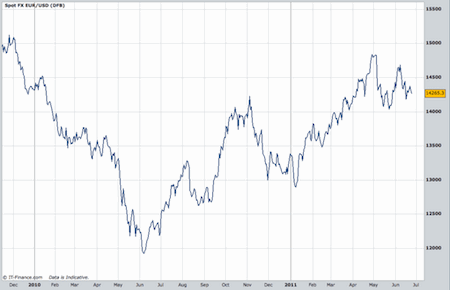
There’s no doubt that fears of a Greek default caused the euro to take a dive last year, but since June 2010 it’s been climbing in value, albeit a rather chopping ascent.
So, what’s the good news that it’s rising on? The Greek problem hasn’t gone away – so where is all this euro strength coming from?
Does George Papandreou have a stash of gold under his bed (well, it wouldn’t surprise me)? Is there untapped oil under the Dolomites (less likely)?
The mistake that we lay observers of the forex markets often make is to associate the wealth of a country with the value of its currency.
 Economist and social philosopher Ludwig von Mises wrote, “The valuation of a monetary unit depends not on the wealth of a country, but rather on the relationship between the quantity of, and demand for money. Thus, even the richest country can have a bad currency and the poorest country a good one.”
So, the euro isn’t strong – it’s just not in as bad a state as the dollar.
Rather than look at what the euro might be doing “right” – we should be considering what other major currencies are getting “wrong”.
The chart below shows how the major banks have responded with “bailouts”. We can clearly see that the Bank of England and the Fed have embarked on a massive programme of printing money, while the ECB has been relatively restrained.
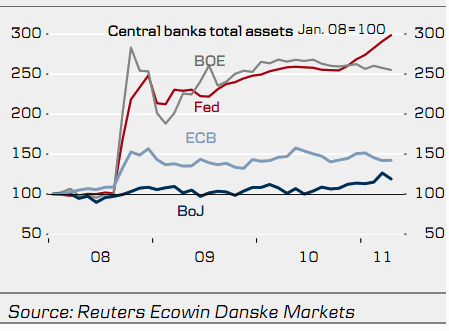
And the simple equation is that printing money makes the value of that money go down.
The European Central Bank hasn’t printed as much money as the Bank of England or the Fed, therefore the euro has stayed relatively strong.
When the euro hits the fan
So, if the euro is actually doing rather well … its manufacturing PMI surveys point to renewed strength … the ECB are hinting at an interest rate rise in July …
Should we all be going long on the euro?
Of course, it’s not that simple.
Most economists agree that the Greek debt problem can’t be “managed” indefinitely – at some point they will need to restructure that debt. And this process will be politically and economically explosive.
So, we should be shorting the euro, right?
Well, there are a number of commentators telling investors to do just that.
I’m not one of them.
The ultimate value of the euro once this storm has blown over will depend on who’s left in the game.
If it’s shaken off the poorer member states, investors who’ve been shorting the euro could be left on the wrong side of a high-value “deutchmark-euro”.
(This is exactly what German is working so hard to avoid – a high-value currency will make their exports too expensive for overseas buyers.)
So, how do we play the euro crisis?
Having listened to what the economists are saying, read the various reports, and weighed up the fundamentals, one thing is clear …
… no one knows which way the euro will go.
There is no surefire “short the euro” trade.
The long-term trend on the EUR/USD chart remains bullish, and as traders we have to follow what we “see” in the charts, rather than what we “think” might happen.
That said, there’s no doubt that there will be significant volatility in the months ahead.
For short-term traders, this means plenty of movement on the charts, and plenty of pips to be made.
If you’re after some protection from the volatility of the euro, you’ll need to look further afield that the GB pound or US dollar – both are massively exposed to European debt.
The economies that will fare best through the eye of the euro storm will be emerging nations. Yes, their export markets will take a hit, but they do offer a relatively safe haven away from the eurozone woes.
Until next time,
Mark Rose