February 7, 2014by Mark Rose- 1 comment
Guess who’s back?
There’s a sector that the professionals are getting very excited about at the moment. They’re talking about a low-point in the ‘super cycle’ and are loading up on cheap rock-bottom shares.
This is a sector that’s had a torrid time since the global financial crisis. And 2013 was a really terrible year. Investors are seriously out-of-love with it. Which is precisely the time that things usually get interesting …
The sector is commodities. Something that’s become a dirty word over the past three years … but suddenly there’s a rumbling from the pits of the mercantile exchanges …
… people are buying.
These are the raw materials that people around the planet rely on – the energy, metals and agricultural resources, like oil, gold, cotton, rice, lean hogs …
Of course, if you’re trading these commodities, you’re not actually going to get a delivery of cocoa beans or copper turning up at your back door, but they still feel more tangible than anything the forex markets or shares have to offer – the world will always need food delivered to its supermarket shelves.
But what went wrong for commodities?
It doesn’t seem that long ago that people were making their fortunes in commodities.
Emerging markets were demanding more and more resources … fears about supply and shipment were everywhere …
This chart shows the fortunes of commodities over the past 20 years …
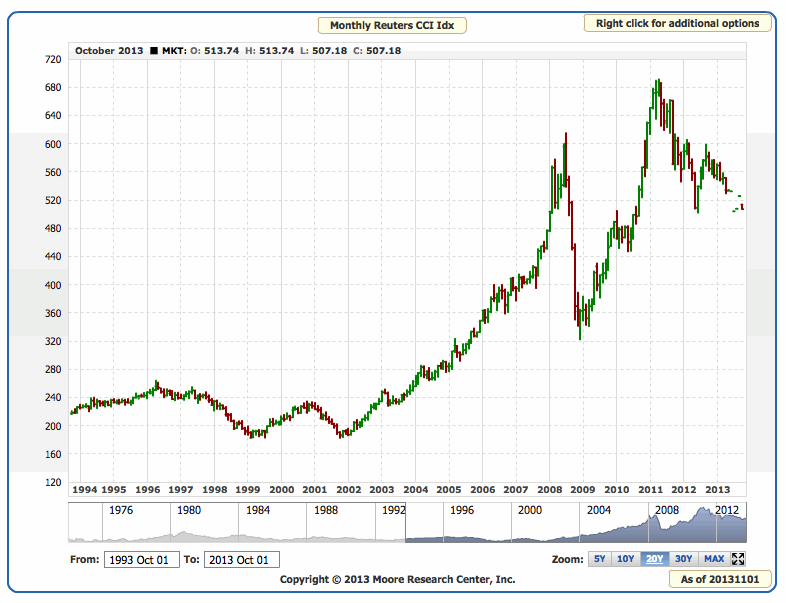
It’s not hard to see how commodities have made some people very rich, very quickly.
But then the global financial crisis hit … and despite breaking new highs in 2011, the last three years haven’t been kind to commodity traders …
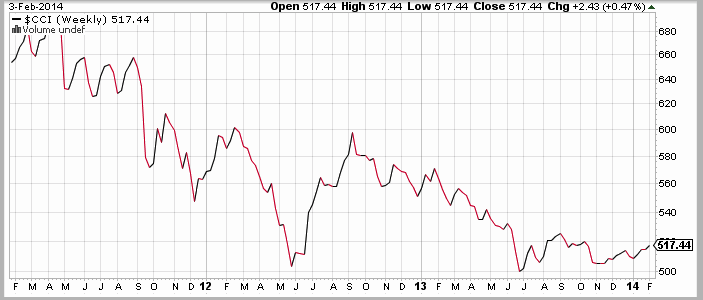
So why should we think this is the bottom of the commodity super cycle?
Commodities traditionally have a link to global GDP. When GDP accelerates, commodities tend to do well, as demand for raw materials for industry, energy to keep the factories running, and stuff on the supermarket shelves goes up.
And the general consensus is that global GDP is poised to accelerate in 2014.
In December, 15 out of the 22 nations reporting manufacturing data saw gains accelerate.
Meanwhile, in the past three years, the equity markets have been doing very nicely, and there’s a feeling that they are overstretched, artificially buoyed up by the loose monetary policy that the US is now scaling back on with their tapering policy.
Investors are faced with the choice – put your money into expensive equities or cheap commodities …?
But let’s not be too hasty.
There’s a reason why traders can be shy of commodities
Many people who’d made money in the boom period, then lost a lot of money in 2008, when commodity prices fell through the floor. And just a glance at the monthly candlesticks on that 20-year chart shows how volatile this market has been over the past 6 years.
Buying commodities has demanded a strong nerve, and deep pockets to be able to ride those turbulent ups and downs.
Plus, there’s another problem …
We talk about commodities as if they are one entity, but in fact there’s a huge disparity between the winners and the losers in the commodity sector.
This table for the past decade shows how there was almost a 200% gap between the winning commodity (nickel) and the loser (natural gas) in 2006 …
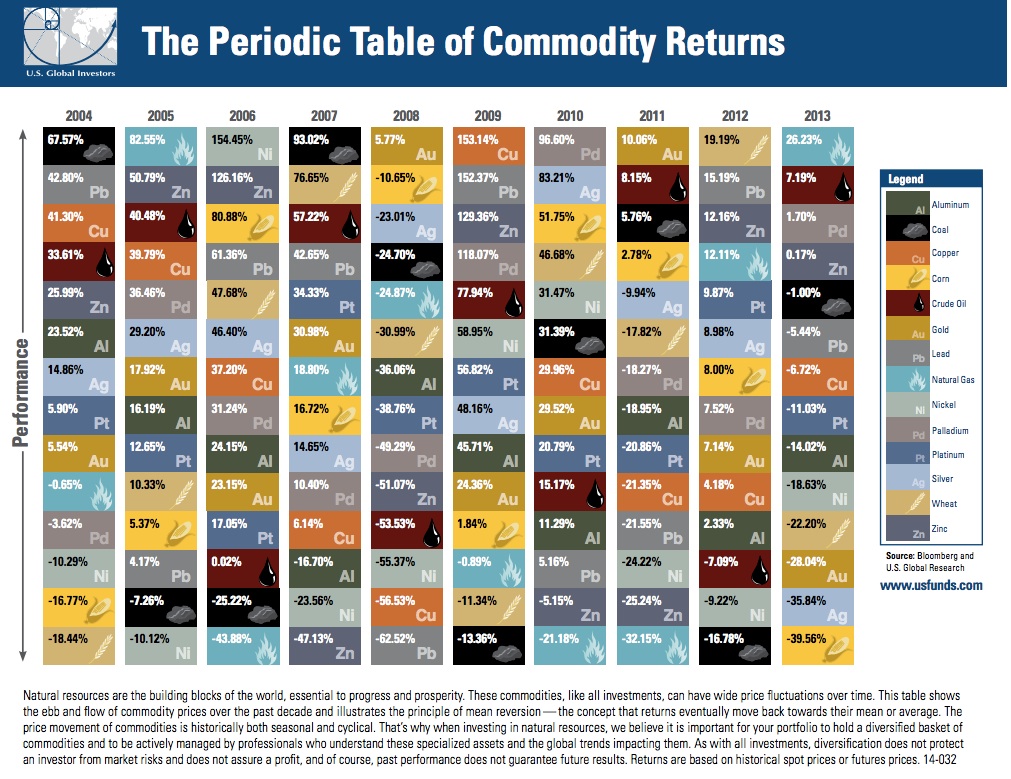
As I talked about in my post last week – we’ve got to be mindful of how we manage this volatility, and, as the chart above shows, correlation between different commodities can be tough to manage.
My expectation is that we haven’t yet seen the bottom for commodities in general – there’s probably still some downside to come.
However, now is the moment to be watching and waiting for the right way to play commodities. This market has immense power to make money for us because of its volatility. But we MUST protect ourselves from that volatility at the same time, because we don’t have unlimited resources to ride through the inevitable ups and downs.
Expect to hear a lot more about commodities in the coming months …







1 comment
DW
Having missed out on the commodities boom last time around, it would be good to get a slice of the action next time around, but like you say – current volatility across all markets is pretty hairy. I’m certainly going to be shutting up my trades ahead of this afternoon’s non-farm payrolls. Anyone out there thinking of taking a risk on them?